

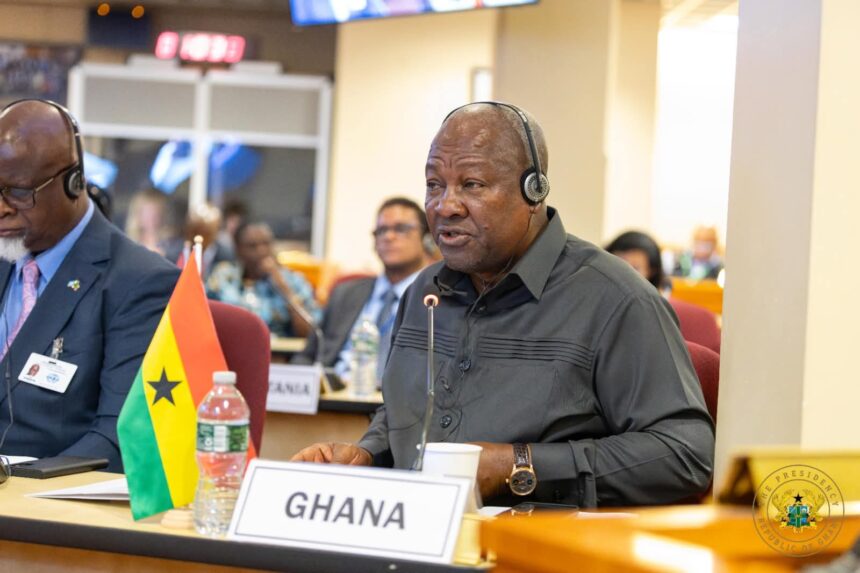
President John Dramani Mahama has described the adoption of a resolution declaring the Transatlantic Slave Trade as the gravest crime against humanity as a major step toward healing and advancing reparative justice for millions of affected people across the world.
Delivering remarks at a High-Level Special Event on Reparatory Justice at the United Nations Headquarters on Tuesday, March 24, the Ghanaian leader said the resolution represents global recognition of the immense suffering endured by more than 12.5 million Africans who were forcibly taken from their homes over a period spanning four centuries. The event, held under the theme “Reparatory Justice for the Trafficking of Enslaved Africans and the Racialised Chattel Enslavement of Africans,” brought together global leaders and stakeholders to address historical injustices and their lasting consequences.
Mahama noted that the resolution provides an opportunity for the international community to acknowledge the deep human cost of the transatlantic slave trade, including the loss of identity, families, cultures, and futures. He emphasised that the initiative is not only about historical recognition but also about confronting the enduring legacy of inequality and injustice rooted in slavery.
Speaking on whose behalf he addressed the gathering, Mahama said his message reflected a collective voice that extends beyond Ghana to include the entire African continent, as well as the Caribbean, Latin America, and the global African diaspora. He added that the resolution resonates with all people committed to justice and human dignity, regardless of geography.
The President further described the resolution as both a moral and historical milestone, stressing that it serves as a pathway toward healing while also preserving the memory of those who suffered. According to him, formally recognising the transatlantic slave trade as a grave crime against humanity is essential to ensuring that such atrocities are neither forgotten nor repeated.
His comments come at a time of increasing global advocacy for the acknowledgment of historical injustices, with renewed calls for reparations and a broader commitment to addressing the long-term social and economic impacts of slavery.
