

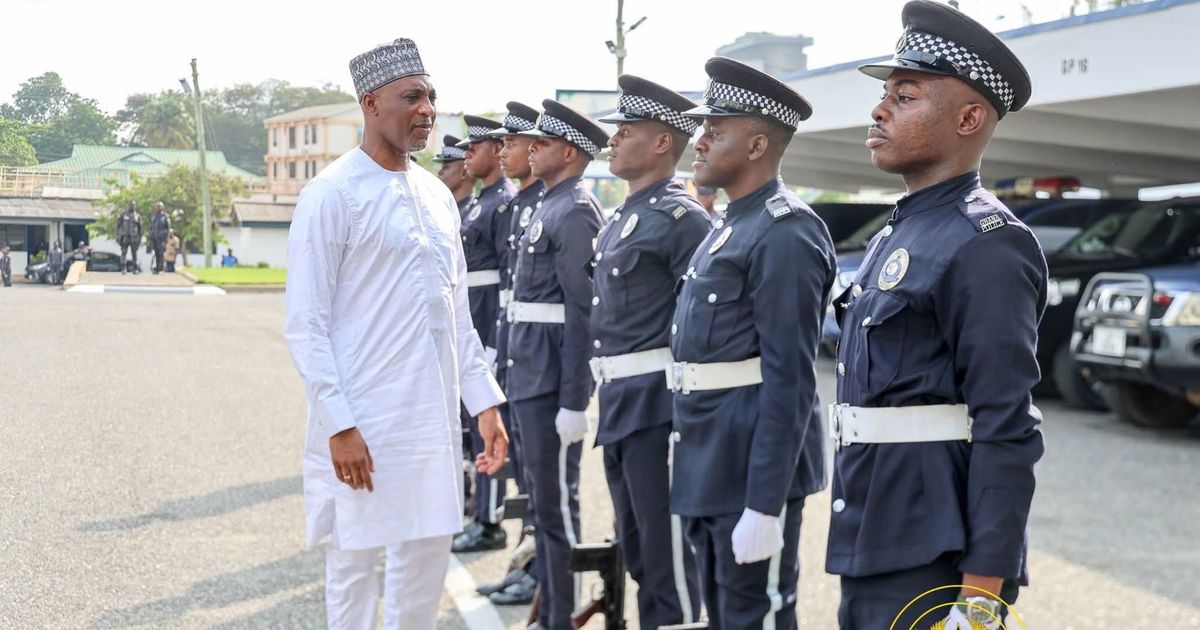
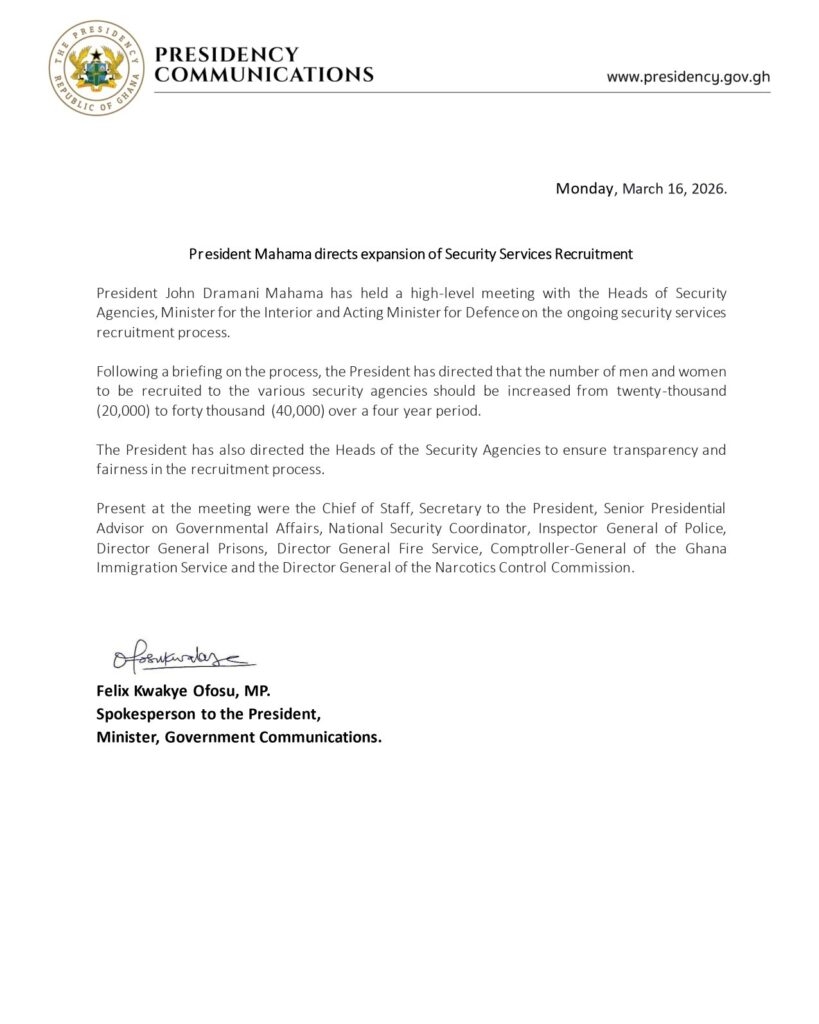
President John Dramani Mahama has officially directed a massive expansion of the nation’s security apparatus, ordering a 100% increase in recruitment quotas to see 40,000 new personnel drafted into various services over the next four years.
The directive was issued following a high-level strategic briefing at the Jubilee House on Monday, March 16, 2026, where the President met with the Minister for the Interior, the Acting Minister for Defence, and the heads of all major security institutions. This move effectively doubles the government’s previous commitment of 20,000 recruits, a decision driven by the need to fortify national stability and provide a sustainable solution to the burgeoning youth unemployment crisis.
According to government spokesperson Felix Kwakye Ofosu, this surge in personnel is a foundational requirement for the successful implementation of the President’s “24-Hour Economy” policy, which relies heavily on enhanced security visibility to protect round-the-clock commercial activities. By bolstering the ranks of the Ghana Police Service, the Ghana Immigration Service, the Ghana National Fire Service, and the Prisons Service, the administration aims to improve the citizen-to-officer ratio, which has come under pressure as Ghana’s population approaches 35 million.
The scale of the recruitment drive is supported by sobering statistics from the Ghana Statistical Service, which currently pegs youth unemployment at approximately 32%. The urgency of the situation was underscored just last week when the Ministry of the Interior revealed that over 500,000 young Ghanaians applied for a mere 5,000 available slots in the most recent recruitment cycle. This “human capital reservoir,” as described by the President, provides an ample pool of talent, with over 105,000 applicants having already cleared preliminary aptitude tests and physical screenings.
To maintain public trust, President Mahama emphasized that this expanded process must be anchored in meritocracy and absolute transparency. He issued a stern warning to the Inspector-General of Police, the Comptroller-General of Immigration, and other service chiefs to eliminate the influence of “protocol lists” and middlemen. The Director-General of the Narcotics Control Commission and the heads of the Prisons and Fire Services were also present to receive the mandate, which seeks to ensure that every qualified Ghanaian has a fair opportunity to serve.
This 40,000-person target will be phased over a four-year period to ensure that the national budget can accommodate the increased wage bill without triggering the fiscal instability often cautioned against by international monitors like the IMF. Beyond domestic policing, the expansion is also viewed as a strategic move to tighten border controls against regional volatility and modernize emergency response capabilities across the country.
